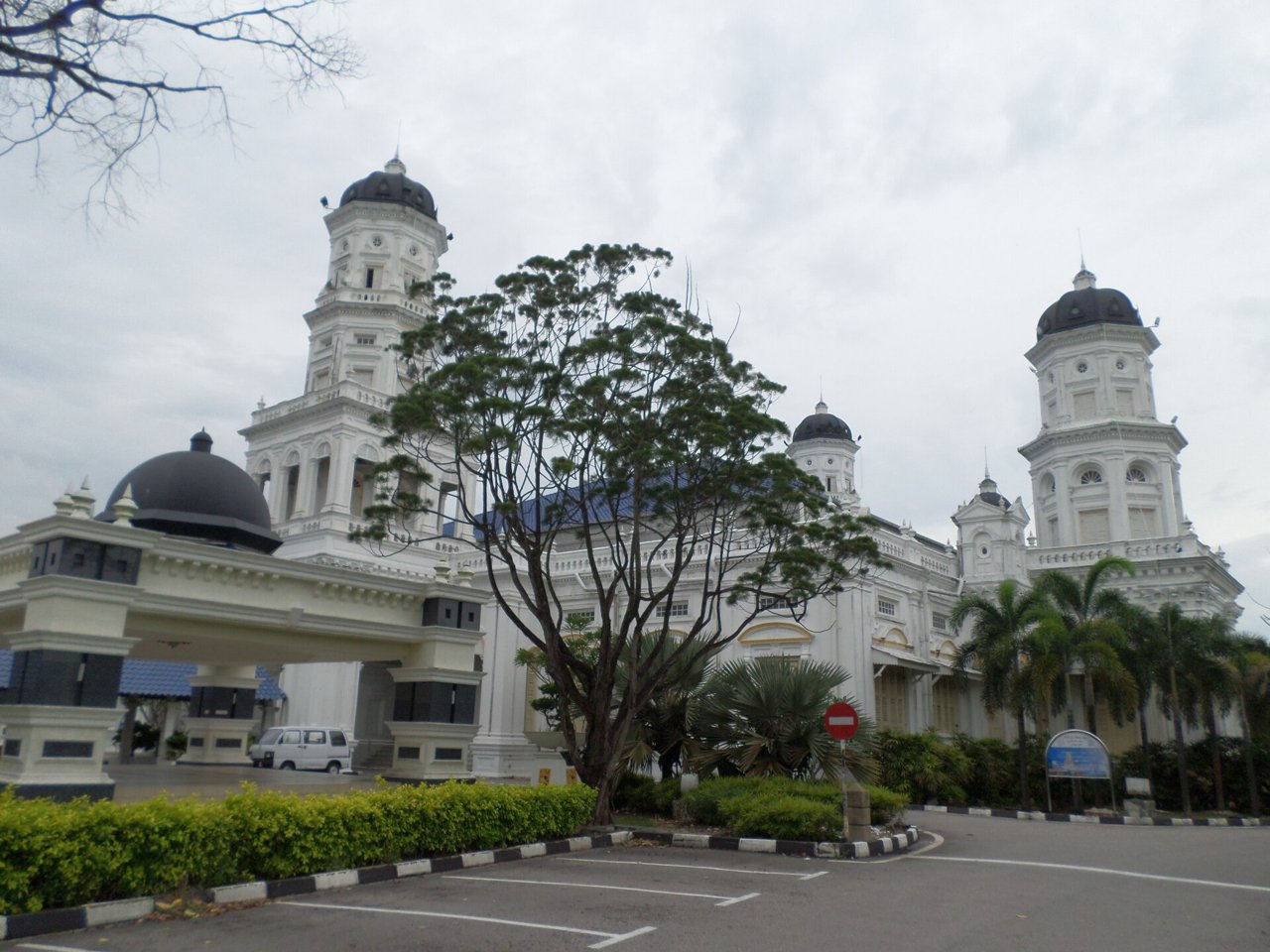
Johor Bahru's skyline mixes a 19th-century royal palace, a Victorian-Moorish state mosque and a modern mall tower — and the best of them sit within a short Grab ride of KSL D'Esplanade.
Most visitors come to JB for food and shopping, but the old city centre hides a surprising cluster of heritage landmarks — palaces, mosques and temples that tell the story of how a fishing settlement became the capital of Johor. Here are five of the most iconic buildings, what makes each one worth a look, and how to fit them around a weekend stay.
Why is the Sultan Abu Bakar State Mosque so unusual?
The Sultan Abu Bakar State Mosque 📍 Map looks like almost no other mosque in Malaysia. Built between 1892 and 1900 and designed by Tuan Haji Mohamed Arif bin Punak, it blends Victorian and Moorish architecture — its minarets are shaped like British 19th-century clock towers rather than traditional Islamic ones. It sits on a hill overlooking the Straits of Johor and can hold around 3,000 worshippers. Non-Muslim visitors are usually welcome outside prayer times with modest dress; check current visiting hours before you go.
Can you visit the Grand Palace (Istana Besar)?
The Istana Besar 📍 Map, or Grand Palace, was built in 1866 under Sultan Abu Bakar — often called the “Father of Modern Johor.” Its Anglo-Malay design pairs a Malay-style dome with a blue Anglo roof, and its halls were once filled with European furniture. Inside is the Royal Abu Bakar Museum 📍 Map, opened in 1990, holding royal heirlooms. Note that the palace is used for state functions and public access to the royal museum has varied over the years, so admire the grounds and architecture from outside — check current access and opening status before visiting.
What is the story behind the Sultan Ibrahim Building?
Standing on Bukit Timbalan, the Sultan Ibrahim Building 📍 Map was constructed between 1936 and 1939 and completed in 1940 as Johor's state secretariat. Designed by the British firm Palmer and Turner, it fuses Western and Saracenic styles and was one of the tallest buildings in Malaya before independence. During the 1942 Japanese occupation, the Japanese army used it as a command post while planning the invasion of Singapore, and it survived the war. It's best appreciated from the outside as a photo stop.
Which buildings show JB's Chinese heritage & modern side?
The Johor Bahru Old Chinese Temple 📍 Map dates to the 1870s and was founded by Chinese leader Tan Hiok Nee. It enshrines five deities linked to the city's main dialect communities — a symbol of unity among clans who once feuded. Every year around the first lunar month it hosts the Chingay “Parade of Deities,” which draws huge crowds (check current festival dates). For a modern contrast, KOMTAR JBCC 📍 Map — a two-storey shopping arcade under a 25-storey office block near JB Sentral — reopened in its current form in 2014 and is a handy air-conditioned stop near the CIQ border.
How do I fit these landmarks into a JB trip?
All five sit in or near the old city centre, so you can pair a heritage morning with an afternoon of food and shopping — see our wider list of things to do in Johor Bahru. Most are a 10–20 minute Grab ride from the KSL area; our guide to getting around JB without a car covers the easiest ways to hop between them.
Base yourself at KSL D'Esplanade and you're a short ride from all of these landmarks with the mall and food streets downstairs. See our Studio and 2-bedroom units, then message us on WhatsApp to check availability for your dates.
Comments
No comments yet — be the first.